Agile vs Waterfall comes down to one question: how much do you know before you start, and how expensive is it to change your mind later? Waterfall plans the whole job up front and moves through defined stages in order. Agile delivers in small increments, gets feedback and re-plans as it learns. Waterfall suits stable, well-understood work where late change is costly; Agile suits work where the right answer only becomes clear once people see something real.
Most teams do not need to pick a side forever. This comparison covers what each approach actually is (including what its origins say), seven differences that matter day to day, honest pros and cons, five real-world scenarios, a scoring framework you can use in a planning meeting, and how to make a hybrid work without getting the worst of both.
Agile vs Waterfall at a glance
Planning
- Waterfall
- Detailed plan up front, then a baseline
- Agile
- High-level plan, detail added each iteration
Requirements
- Waterfall
- Fixed early, changes go through change control
- Agile
- Expected to evolve; backlog is re-ordered
Delivery
- Waterfall
- One main delivery at the end, or by phase
- Agile
- Working increments every few weeks
Customer involvement
- Waterfall
- Heavy at the start and at acceptance
- Agile
- Regular reviews throughout
When problems surface
- Waterfall
- Often late, at testing or integration
- Agile
- Early, in each review
Progress measured by
- Waterfall
- Phases and milestones completed
- Agile
- Working results delivered and accepted
Contract shape
- Waterfall
- Fixed scope, then time and cost
- Agile
- Often fixed time and budget, flexible scope
Typical fit
- Waterfall
- Construction, manufacturing, regulated rollouts
- Agile
- Software, digital products, campaigns
| Criterion | Waterfall | Agile |
|---|---|---|
| Planning | Detailed plan up front, then a baseline | High-level plan, detail added each iteration |
| Requirements | Fixed early, changes go through change control | Expected to evolve; backlog is re-ordered |
| Delivery | One main delivery at the end, or by phase | Working increments every few weeks |
| Customer involvement | Heavy at the start and at acceptance | Regular reviews throughout |
| When problems surface | Often late, at testing or integration | Early, in each review |
| Progress measured by | Phases and milestones completed | Working results delivered and accepted |
| Contract shape | Fixed scope, then time and cost | Often fixed time and budget, flexible scope |
| Typical fit | Construction, manufacturing, regulated rollouts | Software, digital products, campaigns |
What Waterfall actually is
Waterfall is a sequential approach: requirements, design, build, test and deploy (or the equivalent stages in your industry), each largely completed and approved before the next begins. Formal phase gates, a signed-off baseline and a change-control process are its defining tools.
Its origin story is often told wrong. The model is usually traced to Winston Royce’s 1970 paper on managing large software projects, but Royce described the simple step-by-step sequence as risky for large software efforts and recommended feedback between stages, early prototyping and close customer involvement. He did not call it “waterfall”; that label came later. In other words, even the paper credited with Waterfall argued for some iteration.
Waterfall earns its place when the work is physical, contractual or regulated. You cannot pour a building’s foundations iteratively, a medical device needs documented verification against agreed specifications, and a fixed-price public tender usually requires scope to be defined before bidding. In those settings, up-front planning is not bureaucracy; it is how risk is managed.
What Agile actually is
Agile is a set of values and principles rather than a single method. The Manifesto for Agile Software Development, written in 2001, favors individuals and interactions, working software, customer collaboration and responding to change, while still recognizing value in processes, documentation, contracts and plans. Its principles include delivering working software frequently, from a couple of weeks to a couple of months, and welcoming changing requirements even late in development.
Specific frameworks put those ideas into practice. Scrum organizes work into Sprints of one month or less with defined accountabilities and events. Kanban focuses on visualizing work and limiting work in progress to improve flow. If you are choosing between those two, our Kanban vs Scrum comparison covers the details.
Although Agile began in software, the underlying idea, deliver something small, learn, adjust, works anywhere the requirements are uncertain: marketing campaigns, service design, internal tooling, even parts of hardware development such as prototyping.
Seven differences that matter in practice
1. When you commit to scope
Waterfall commits to scope early and protects it. Agile commits to a goal and a budget or timebox, and lets the exact scope flex. Neither removes commitment; they commit to different things. Ask your sponsor which they actually need to be fixed: the feature list, the date or the cost.
2. How change is handled
In Waterfall, change after the baseline is a formal event: a change request, an impact assessment and an approval. That is slow, but it protects downstream work that depends on stable specifications. In Agile, change is routine; new information simply re-orders the backlog for the next iteration. The cost is that long-range forecasts are less precise.
3. When risk surfaces
Waterfall tends to concentrate risk at the end. If the design was misunderstood, you may find out at user acceptance testing, when fixing it is expensive. Agile exposes risk early because something usable is reviewed every few weeks. The trade-off is that Agile can lose sight of the big picture if nobody owns the overall goal and architecture.
4. How progress is measured
A Waterfall status report says “design is 100% complete, build is 60% complete”. That can look healthy while nothing works yet. Agile measures progress by working, accepted increments, which is harder to fake but harder to translate into a date for the final scope.
5. The customer’s role
Waterfall front-loads customer input into requirements and sign-off, then the customer waits. Agile needs the customer or a product owner available every iteration to review work and make priority calls. If your client cannot commit that time, Agile will struggle no matter how good the team is.
6. Documentation
Waterfall relies on comprehensive documents because they are the hand-off between stages and teams. Agile keeps documentation lighter and closer to the work. Agile does not mean no documentation; regulated Agile teams still produce evidence, they just produce it continuously.
7. Budgets and contracts
Waterfall pairs naturally with fixed-price, fixed-scope contracts. Agile pairs more naturally with time-and-materials or fixed-budget contracts where scope is prioritized within the budget. Many client agencies use a middle path: a fixed price for a defined discovery phase, then a fixed budget per release with scope agreed sprint by sprint.
Pros and cons
Strengths
- Waterfall
- Predictable plans and budgets when scope is stable; clear documentation and approvals; easy to explain to non-specialists
- Agile
- Early feedback and risk discovery; adapts to change; delivers usable value sooner; keeps the team close to users
Weaknesses
- Waterfall
- Late discovery of misunderstandings; change is slow and costly; little usable output until late
- Agile
- Final scope and date harder to promise; needs an engaged product owner; can drift without a clear goal
Fails when
- Waterfall
- Requirements are guessed rather than known
- Agile
- Stakeholders cannot review regularly or keep changing priorities mid-iteration
| Waterfall | Agile | |
|---|---|---|
| Strengths | Predictable plans and budgets when scope is stable; clear documentation and approvals; easy to explain to non-specialists | Early feedback and risk discovery; adapts to change; delivers usable value sooner; keeps the team close to users |
| Weaknesses | Late discovery of misunderstandings; change is slow and costly; little usable output until late | Final scope and date harder to promise; needs an engaged product owner; can drift without a clear goal |
| Fails when | Requirements are guessed rather than known | Stakeholders cannot review regularly or keep changing priorities mid-iteration |
Five examples: which approach fits?
A clinic refurbishment: Waterfall
A healthcare provider is refurbishing a clinic. Building regulations, infection-control standards and contractor sequencing (strip-out, services, partitions, finishes, commissioning) are known in advance and costly to change once work starts. Design and sign-off happen before contractors arrive. Waterfall, with formal gates at design approval and handover, fits.
A SaaS onboarding redesign: Agile
A product team wants more trial users to reach their first useful result. Nobody knows in advance which changes will help. The team ships one change at a time, measures activation, and uses Sprint Reviews to decide what to try next. Our sprint planning guide covers how to turn that kind of goal into a sprint plan.
An agency e-commerce build: hybrid
A digital agency has a fixed launch date before a client’s peak season, a fixed budget and agreed integrations with payment and stock systems. Those constraints are planned up front as milestones. Inside them, page templates, merchandising features and content are built in two-week sprints and reviewed with the client, who can re-prioritize within the budget.
A payroll system migration: hybrid
A finance team is moving payroll to a new provider. Cutover dates, parallel runs and compliance checks must follow a strict, sequential plan. Configuration of reports and approval workflows, however, benefits from short cycles of build and user review. The team runs Waterfall gates for cutover and Agile iterations for configuration.
A marketing team’s quarterly program: Agile
A B2B marketing team runs webinars, content and paid campaigns. Priorities shift as results come in. The team plans quarterly goals, works in two-week cycles and reallocates budget toward what performs. This is Agile in spirit, often run with a Kanban board.
A decision framework you can use in a planning meeting
Score each question from 1 to 3 and add up the result. It will not make the decision for you, but it turns a philosophical debate into a concrete conversation about your project.
How well are requirements understood?
- 1 point (lean Waterfall)
- Fully specified and stable
- 3 points (lean Agile)
- Unclear; users will refine them
What does a late change cost?
- 1 point (lean Waterfall)
- Very expensive (rework, materials, re-approval)
- 3 points (lean Agile)
- Cheap; mostly re-prioritizing
Can users review partial results?
- 1 point (lean Waterfall)
- No, only the finished whole is meaningful
- 3 points (lean Agile)
- Yes, increments are usable
How available is the customer or product owner?
- 1 point (lean Waterfall)
- Only at start and end
- 3 points (lean Agile)
- Every iteration
What is contractually fixed?
- 1 point (lean Waterfall)
- Scope
- 3 points (lean Agile)
- Date and budget, scope flexible
How heavy is the regulatory or approval burden?
- 1 point (lean Waterfall)
- Formal stage approvals required
- 3 points (lean Agile)
- Light, or evidence can be produced continuously
| Question | 1 point (lean Waterfall) | 3 points (lean Agile) |
|---|---|---|
| How well are requirements understood? | Fully specified and stable | Unclear; users will refine them |
| What does a late change cost? | Very expensive (rework, materials, re-approval) | Cheap; mostly re-prioritizing |
| Can users review partial results? | No, only the finished whole is meaningful | Yes, increments are usable |
| How available is the customer or product owner? | Only at start and end | Every iteration |
| What is contractually fixed? | Scope | Date and budget, scope flexible |
| How heavy is the regulatory or approval burden? | Formal stage approvals required | Light, or evidence can be produced continuously |
A total of 6 to 9 leans Waterfall, 15 to 18 leans Agile, and anything in between suggests a hybrid. When the answers split sharply, for example fixed regulation but very unclear user needs, that is a strong signal to separate the project into parts with different approaches. Whichever way you lean, the plan itself still matters; see our guide on how to create a project plan.
Making hybrid work
Hybrid is the most common real-world answer, and also the easiest to get wrong. Teams end up with Waterfall’s paperwork and Agile’s unpredictability. Four rules help:
- 1.Write down what is fixed and what flexes. For example: launch date and security requirements fixed; feature scope within the budget flexible.
- 2.Put gates only where a downstream commitment depends on them, such as signing a supplier contract or starting a data migration.
- 3.Define how changes are approved at each level. Small backlog changes are the product owner’s call; anything that moves a milestone goes to the sponsor.
- 4.Report progress in both languages: milestones against the baseline for sponsors, and sprint results for the team.
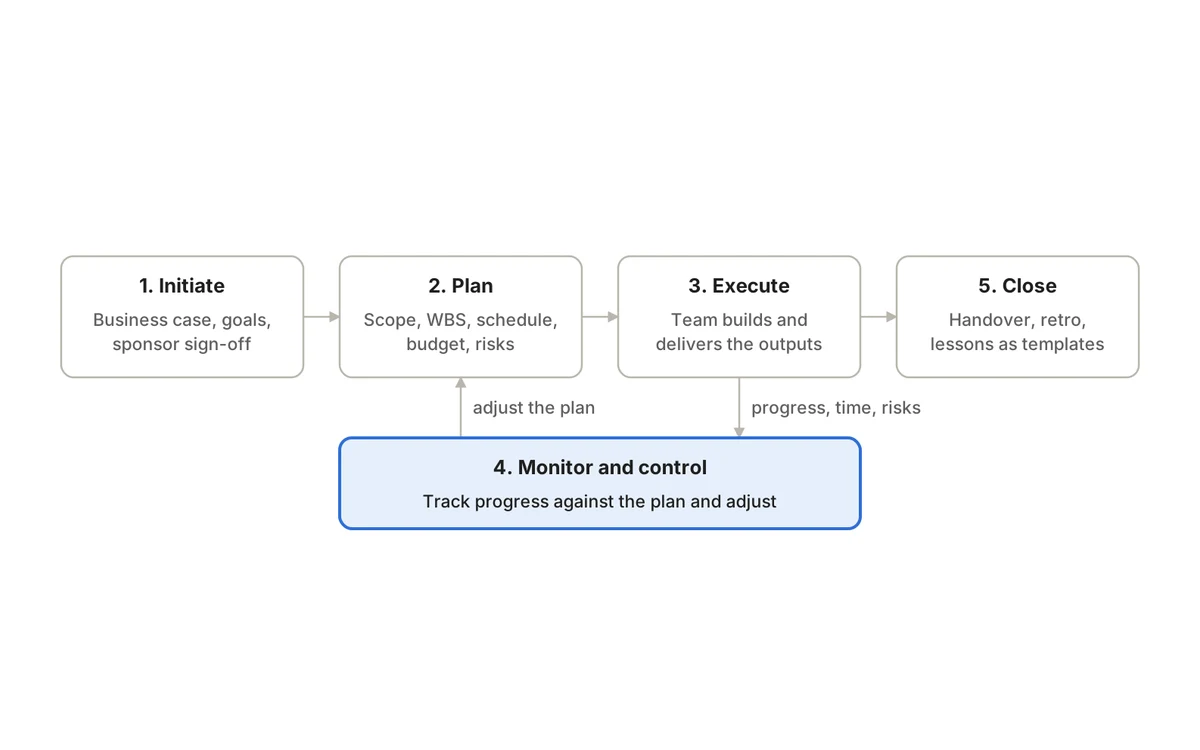
The five project phases still apply in every case; only their rhythm changes. Our guide to project management phases shows how initiation, planning, execution, monitoring and closing map onto each approach.
Five myths worth dropping
- “Agile means no planning.” Agile plans constantly, just in shorter horizons. A well-run product backlog is a plan.
- “Waterfall never iterates.” Royce’s original paper recommended feedback loops and prototypes.
- “Agile is always faster.” It delivers something usable sooner, but total delivery time depends on the work and the team.
- “Waterfall is outdated.” It remains the sensible default for physical, sequential and heavily regulated work.
- “Agile only works for software.” The values apply wherever requirements are uncertain and partial results can be reviewed.
Where QuikProjects fits
Because most organizations run more than one approach, the useful question about a tool is whether it forces one. In QuikProjects, product teams can run Scrum or Kanban with a ranked backlog, sprints and velocity locked at sprint close, while project leads map milestones and dependencies on a timeline that warns when dates conflict. Requirements and decisions live in the project wiki beside the work, and timesheets feed planned-versus-actual hours, so a hybrid project can be reported both by sprint and against its milestone baseline in the same workspace.
Frequently asked questions
Is Scrum the same as Agile?
No. Agile is the broader set of values and principles; Scrum is one framework for applying them, with Sprints, defined accountabilities and set events. Kanban, Extreme Programming and others are different ways to work in an Agile spirit.
Can you use Agile with a fixed budget and deadline?
Yes, and it is common. Fix the time and money, then prioritize scope inside them so the most valuable work is delivered first. What you cannot also fix in advance is every detail of the final scope.
Which is better for a small team?
Small teams usually benefit from lightweight Agile practices because they can talk daily and change course cheaply. But a small team building something sequential and well specified, such as an event or an office move, may be better served by a simple Waterfall plan with clear milestones.
Is Waterfall still used?
Yes. Construction, manufacturing, infrastructure and many regulated projects rely on sequential, gated delivery. Many software organizations also use Waterfall-style gates for releases, compliance or hardware dependencies around Agile development.
The bottom line
Choose Waterfall when requirements are stable and late change is expensive, Agile when learning from users is the point, and a deliberate hybrid when you have fixed commitments around uncertain detail. Decide by the work, not by fashion, and revisit the choice as the project teaches you more. For a broader primer on methodologies, roles and tools, see our guide to project management.
Run sprints, milestones and documentation side by side. Start free with QuikProjects for up to 10 users, no credit card needed.
Sources
See it running on your business.
A walkthrough built around how your team works today.